Walk into almost any conversation about technology these days and the same three letters show up: AI. It powers the recommendations on your favorite shopping app, the autocorrect that saves you from embarrassing typos, the voice assistant that sets your morning alarm, and the filters that make your photos look like they were shot by a pro.
Yet for all that ubiquity, very few people can actually explain what AI is. And that's not your fault. The term gets thrown around so loosely — by marketers, by the news, by your cousin who "totally gets computers" — that it's become more buzzword than concept.
So let's clear the air. This guide is written for absolute beginners. No math, no code, no hype. By the end, you'll understand what AI really means, how it learns, why it sometimes seems scarily smart, and what it can and can't do today. Think of it as the friend who finally explains the thing everyone's been nodding along about.
In this guide
What "artificial intelligence" actually means How AI learns: the pattern idea Narrow AI vs. general AI Where you already use AI every day The rise of generative AI What AI can't do (yet) How to start using AI todayWhat "artificial intelligence" actually means
The simplest way to think about AI is this: a computer doing something that used to require human intelligence. That's it. The "artificial" part just tells you the intelligence isn't biological — it's created in software.
Reading a handwritten note, understanding a spoken question, recognizing a face in a crowd, translating a language, driving a car — these are all tasks that traditionally demanded a human brain. When a machine can do them, we call it artificial intelligence.
Here's the key thing to remember: AI is not magic, and it's not alive. It doesn't think, feel, or understand the way you do. It's a very sophisticated pattern-matching engine that has learned from massive amounts of data. When it "answers" you, it's not reasoning like a person would — it's predicting the most likely response based on everything it has seen before.
💡 The one-sentence definition
Artificial intelligence is software that has been trained on huge amounts of examples to recognize patterns and make predictions — including predictions about what makes a good answer, image, or decision.
How AI learns: the pattern idea
You've probably heard the term machine learning thrown around alongside AI. They're related but not the same. Machine learning is the most common method used to build AI today.
Here's the mental picture that makes it click. Imagine teaching a child to tell dogs from cats. You don't hand them a rulebook that says "if it has pointy ears and a wet nose, it's a dog." Instead, you show them dozens of pictures, pointing at each one — "dog, dog, cat, cat" — and over time the child just... gets it. They build an internal sense of the difference, even if they can't articulate the rules.
Machine learning works the same way, at enormous scale. Instead of a few dozen pictures, you feed a program millions. Instead of a child's brain, you have a mathematical model with billions of tiny adjustable knobs. The program makes a guess, checks how wrong it was, and slightly adjusts its knobs to do a little better next time. Repeat that millions of times, and you end up with a model that recognizes dogs and cats — or words, or faces, or spam emails — with stunning accuracy.
This "learn by example" approach is the big reason AI suddenly feels everywhere. We finally have three things at once:
- Massive amounts of data — the entire internet to learn from
- Huge computing power — fast graphics cards that crunch numbers at lightning speed
- Smarter algorithms — better ways to learn from that data
Narrow AI vs. general AI
When people talk about AI being "smart," it helps to split it into two buckets. Almost everything you use today is what experts call narrow AI — sometimes called "weak AI," though that undersells it.
Narrow AI is brilliant at one specific thing. A chess engine can beat grandmasters but can't write a shopping list. A face-recognition system can unlock your phone but can't plan a vacation. These systems are astonishing within their lane and completely useless outside it.
The other bucket is general AI (AGI) — a system that could learn and perform any intellectual task a human can, the way a person can go from cooking breakfast to fixing a car to writing a poem. Here's the honest truth: we don't have general AI. Despite the headlines, no system today thinks broadly like a human. Even the most impressive chatbots are still narrow — extremely capable, but narrow.
| Capability | Narrow AI (today) | General AI (doesn't exist yet) |
|---|---|---|
| Translating languages | Excellent | Hypothetical |
| Recognizing images | Excellent | Hypothetical |
| Understanding context & emotion | Superficial | Hypothetical |
| Adapting to totally new situations | Weak | Hypothetical |
Where you already use AI every day
You might think you've never used AI. Chances are, you've used it dozens of times today without noticing. Here are some of the most common, quietly-running AI systems:
- Search engines — Google, Bing and others use AI to figure out what you actually meant, not just what you typed.
- Recommendation engines — Netflix, YouTube, Spotify, Amazon and TikTok all use AI to predict what you'll want next.
- Spam filters — your email's ability to spot phishing and junk before it reaches you is machine learning in action.
- Voice assistants — Siri, Google Assistant, Alexa and Bixby turn your speech into text, then into actions.
- Maps & traffic — Google Maps predicts journey times and reroutes you based on live data patterns.
- Face & fingerprint unlock — your phone's security relies on AI recognizing your unique biometrics.
- Autocorrect and predictive text — literally a language model, a tiny cousin of the big chatbots.
- Photo apps — sorting faces into albums and improving image quality are AI tasks.
✨ Try this at home
Next time you open Google Maps or your photo gallery, pause and notice the AI at work — the suggested route, the auto-categorized photos, the face tags. It's all around you already.
The rise of generative AI
Over the last couple of years, you've probably noticed a new flavor of AI dominating the conversation: generative AI. The word "generative" simply means it creates new things instead of just recognizing or sorting them.
Before, AI mostly categorized: "this is a cat," "this is spam," "this is your face." Generative AI goes further and produces fresh output — a paragraph of text, a realistic image, a melody, even a short video — from a simple instruction called a prompt.
The tools you've heard about — ChatGPT, Google Gemini, Midjourney, DALL·E, and countless others — all fall into this category. They're built on a type of model called a large language model (for text) or a diffusion model (for images).
Without getting too deep into the plumbing, here's the plain-English version of how a chatbot like ChatGPT works:
That's why it feels conversational. Language, at its core, is a game of predicting what comes next — and these models have simply become extraordinarily good at that game.
What AI can't do (yet)
For all the wonder, it's just as important to know AI's limits. Being realistic about these will save you a lot of frustration:
- It can be confidently wrong. AI chatbots sometimes state incorrect facts with total conviction — a problem called "hallucination." Always double-check important information.
- It doesn't truly understand. A language model has no lived experience. It doesn't know what love, hunger or sunshine feel like. It just knows what words tend to go together.
- It can't reason like a human. It struggles with logic that requires real-world common sense or breaking rules to adapt to new situations.
- It's only as good as its data. If the training data contained bias, the AI can reproduce that bias. That's a real, ongoing concern.
- It has no awareness. It's not conscious, self-aware, or capable of wanting anything. Anthropomorphizing it is a natural human instinct, but it's also a misunderstanding.
⚠️ A note on accuracy
Treat AI as a brilliant assistant, not an infallible oracle. For medical, legal, financial or safety-critical matters, always confirm AI-generated information with a qualified professional.
How to start using AI today
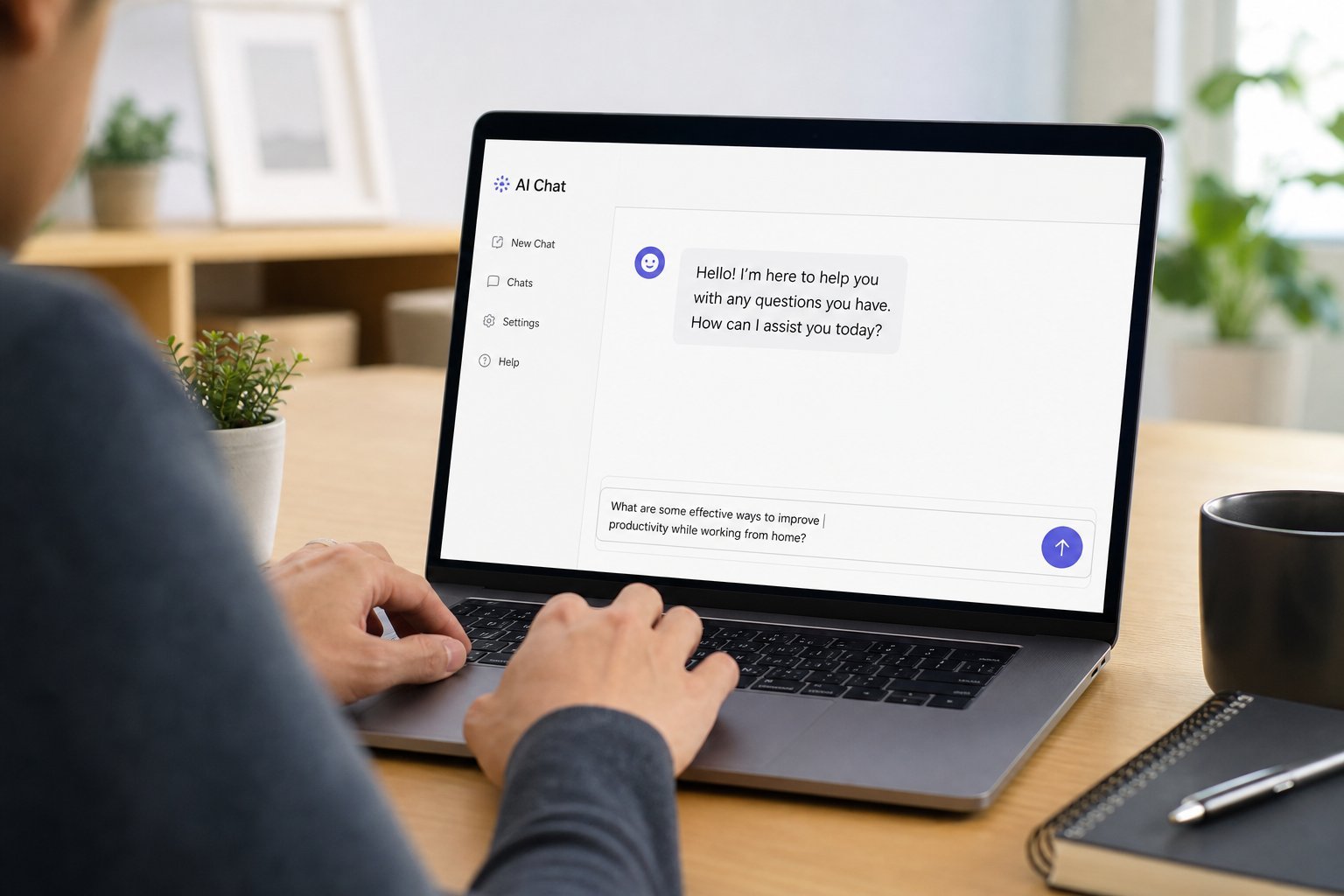
Ready to see it for yourself? You don't need any setup. Here's the fastest way to try generative AI right now:
That's genuinely all it takes to begin. You'll quickly discover that AI is less like a magic genie and more like a fast, knowledgeable, occasionally overconfident research assistant — one that happens to be available at any hour, for free.
📌 The bottom line
AI is software trained on massive data to recognize patterns and make predictions. It powers countless tools you already use, and it's now creating new text, images and more on command. It's astonishingly capable — but it's not conscious, it's not infallible, and it's not going anywhere. Learning to use it well is one of the most useful skills you can build right now.